The Cost of Crowding: Rethinking Breakout Space in UK Training Room Budgets
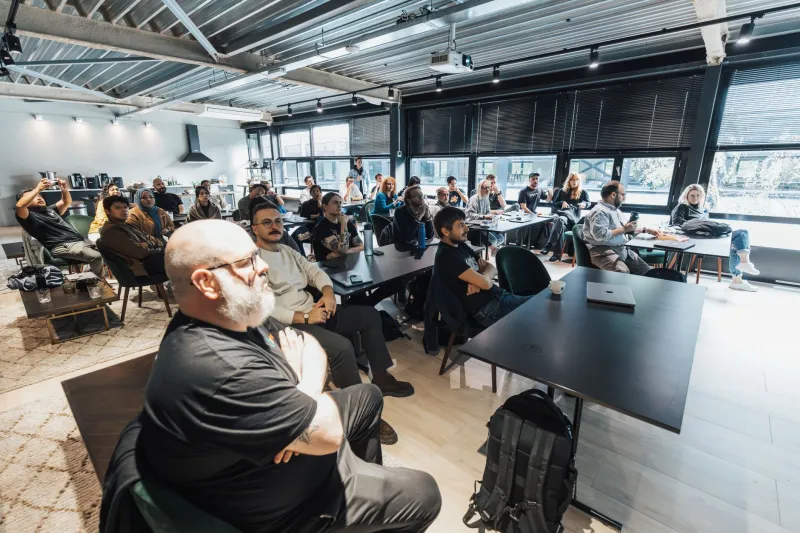
Training room budgets tend to follow a familiar pattern. The main room is scrutinised carefully: capacity, layout, screen, natural light, catering access and the cost per day. Audiovisual hire is itemised. Breakout space, by contrast, is often treated as a secondary question — something to add if the budget allows or if the programme obviously demands it. This is a false economy in many cases, and a genuine waste in others. The task for a hirer is to tell the difference before the agreement is signed.
The argument here is not that every workshop needs a suite of additional rooms. It is that breakout space should be planned with the same discipline as the main room, rather than accepted as an upsell or dismissed as a luxury.
The hidden cost of a single-room plan
A room that seats thirty people can host a presentation for thirty people. It cannot comfortably host four syndicate groups of seven or eight at the same time. If the programme includes group exercises, case discussions or peer coaching, the main room must either be reconfigured repeatedly or used in a way that creates noise, distraction and awkward sightlines.
In practice, groups spill into corridors, reception areas or the back of the room. Some learners find quiet corners; others do not. Facilitators spend time managing movement rather than learning. The session may still run, but the flow is interrupted and the contact time is diluted. The cost of that dilution rarely appears on the invoice. It appears in the evaluation and in the amount of content that has to be compressed later.
A simple test for whether extra space pays
A useful starting point is to list the programme's distinct modes of work. How many learners will be present? How many groups will work simultaneously? Does any group need a closed room for confidential discussion, coaching or assessment? How long will each breakout last? If the answers point to several concurrent groups over a substantial part of the day, the main room alone is unlikely to be sufficient.
A rough calculation helps. Compare the additional hire cost with the value of the session time that would otherwise be lost to reconfiguration, noise management and corridor conversations. If the extra room costs a few hundred pounds and prevents forty learners from losing half an hour of productive group work, the economics may already favour the additional space. This is not an exact science, but it is a more honest comparison than treating the main room as essential and everything else as discretionary.
Configurations that support syndicate work
Adjacent syndicate rooms remain the most reliable solution. They allow groups to speak at normal volume without competing with one another, and they give facilitators a clear circuit for checking in. The important details are proximity, door noise and whether the rooms are genuinely available for the whole session rather than booked in short slots.
Flexible zones within a larger space can work where the programme is less formal. Movable partitions, cabaret seating and designated corners can create semi-private areas for short exercises. They are less suitable for confidential conversations or for groups that need to concentrate for long periods. The test is whether a group can hear itself think, not merely whether it has a table.
A third option is a mix of formal rooms and informal spaces. A quiet lounge or a small meeting room can be used for coaching or reflection, while the main room handles plenary sessions. This can be more economical than hiring four separate syndicate rooms, provided the circulation works and learners are not spending the session walking between distant parts of the building.
Negotiating breakout access without buying unnecessary space
Hirers should ask what is included in the main room rate before discussing upgrades. Some venues include a small meeting room or a breakout area as part of a day delegate package; others charge separately. It is worth asking whether adjacent rooms are available, whether they can be reserved exclusively, and whether the price changes if they are used only for part of the day.
A practical checklist is useful. Confirm the number of rooms, their capacity and their furniture. Ask about acoustic separation and whether the rooms will be used by other clients during the same period. Check access times, refreshment arrangements and whether the rooms can be locked. Ask what happens if the programme overruns. These questions are not adversarial; they are the same questions a venue would expect from any organised client.
At the same time, hirers should resist paying for square footage that the programme will not use. A room described as a breakout suite may be larger than the session requires, or configured in a way that makes group work awkward. The objective is fit, not volume.
When to decline the extra space
If the day is predominantly presentation-led, with only a brief paired exercise, the main room may be adequate. If the breakout activity is short and informal, designated zones may suffice. If the venue's additional rooms are distant, poorly ventilated or acoustically weak, their presence on the invoice does not guarantee better learning.
The breakout room economy is therefore not a simple argument for more space. It is an argument for matching space to method. A training room budget that funds the main room generously and the learning flow poorly is not a balanced budget. The most economical choice is often the one that keeps the session moving, keeps groups productive and avoids the hidden cost of crowding thirty learners into a room designed for a lecture.