The Room Reads You Back: Assessing Light Before Booking a UK Training Space
Most training room enquiries begin with capacity, location and price. Lighting is often treated as a fixed feature of the room, something to be endured rather than specified. In practice, illumination is one of the few variables that affects every learner for the whole session. It determines whether a projection can be read from the back row, whether notes can be taken without strain and whether the room feels alert or soporific by mid-afternoon. For UK hirers, the short winter daylight window makes this more than a technical concern. A room that performs well in June may be a different proposition in November.
Daylight orientation is a booking issue, not a footnote
A training room's compass orientation matters because it predicts when direct sun will enter and where it will land. South-facing windows can deliver useful winter warmth and brightness, but they can also produce low-angle glare across screens and faces from late morning onwards. West-facing rooms may be calm at 9am and difficult at 3pm. North-facing rooms offer more consistent, cooler light, though they can feel flat on a grey January afternoon.
Hirers should ask which direction the main windows face and request a viewing at the time of day the session will actually run. A 9am start needs a different assessment from a 1.30pm workshop. During the UK winter, daylight may be limited to a narrow band between roughly 8am and 4pm, so the artificial lighting has to carry more of the load. That makes the relationship between windows, blinds and electric light the central question.
Glare, screens and the note-taking problem
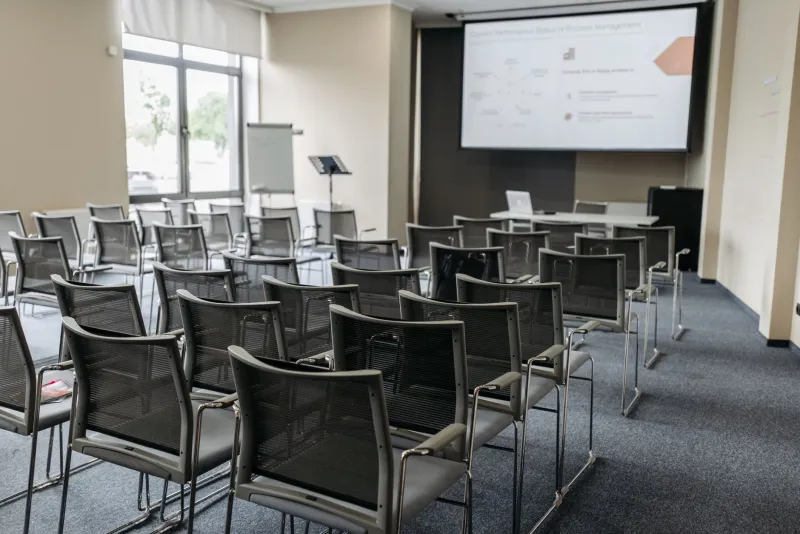
The most common lighting failure in training rooms is not darkness. It is uncontrolled brightness in the wrong place. A window behind the presenter can silhouette the speaker and wash out a whiteboard. A window behind the screen can create a bright rectangle that competes with the projected image. Side windows may throw glare across laptop screens or polished tables, making notes uncomfortable to read.
Ask to see the blinds in operation, not merely to confirm they exist. Are they blackout, diffused or merely decorative? Can they be adjusted partially, or are they all-or-nothing? Who controls them during a session, and are the cords or remotes accessible? A room that must be made completely dark to make the screen readable is not a well-lit training room; it is a room with a lighting compromise. Hirers should test a representative slide on the screen with the blinds at several positions and from the furthest learner position.
Artificial light: lux levels, zoning and colour
Electric lighting is often described in vague terms such as 'bright' or 'good for presentations'. A more useful conversation concerns measured lux levels, dimming zones and colour temperature. General training tasks typically benefit from even, comfortable illumination, while screen-based work may need lower ambient light near the screen and enough task light elsewhere for notes. The precise figures depend on the activity, but the principle is consistent: the room should be adjustable in zones rather than governed by a single switch.
Ask whether the lighting is dimmable, whether it is divided into zones and whether the controls are labelled. A room where dimming the projector area also plunges the note-taking area into gloom will encourage passive viewing rather than active learning. Colour temperature matters too: very cool white light can feel clinical, while very warm light can feel heavy on a winter afternoon. Neither is automatically wrong, but the hirer should know what has been specified and whether it can be changed.
Flicker is harder to see but easier to feel. Some inexpensive lighting systems produce a subtle flicker that can cause headaches or fatigue over a long day. A simple test is to view the room through a smartphone camera; visible banding may indicate a problem worth raising. It is not a definitive measurement, but it is a reasonable screening question.
The afternoon alertness test
Lighting influences more than visibility. Bright, cool morning light can support alertness, while a dim, warm room after lunch may make the post-lunch period harder to manage. This does not mean every training room should be flooded with arctic brightness. It means the lighting should be capable of changing with the session. A room with no dimming and no zoning offers no response to the natural dip in concentration that many groups experience between 2pm and 3pm.
Hirers should view the room at that hour if possible, especially in winter. Check whether the ceiling lights create pools of shadow, whether the presenter can be seen clearly without squinting, and whether the combination of daylight and artificial light produces a calm or a clinical atmosphere. The aim is a room that can be brightened for discussion, softened for screen work and adjusted without a technician.
A practical pre-booking lighting checklist
Before signing, arrange a viewing at the proposed session time and season. Confirm the orientation of the principal windows and note where direct sun falls. Operate every blind and ask who is responsible for adjusting them during the hire. Test the projection screen with the blinds open, partly closed and fully closed. Sit in the back row and at the side of the room, not only at the centre table.
Ask for the lighting zones and controls to be demonstrated. Confirm whether dimming is smooth or stepped, whether the presenter can reach the controls and whether emergency lighting remains effective when the room is dimmed. In winter, request a late-afternoon viewing if the booking runs beyond 3pm. If measurement matters, ask the venue whether recent lux readings are available; otherwise, a calibrated phone application can provide a rough indication, though it should not be treated as a substitute for professional assessment.
Finally, specify fixes in the booking correspondence rather than leaving them to chance. A request for diffused blinds, additional task lighting, a screen repositioning or a labelled dimming plan is more likely to be honoured if it is recorded before the contract is signed. The objective is not to turn the room into a darkened cinema. It is to create a lighting environment that supports the work: readable screens, comfortable notes and learners who remain attentive when the daylight fades.