Before the Welcome Slide: Auditing Arrival Logistics in UK Training Room Hire
Most venue inspections begin in the main room and end there. The chairs are tested, the screen is viewed from the back, and the lighting is adjusted. All of that matters. But the arrival sequence is not a preamble to the learning day; it is the first part of it. Delegates who cannot park, cannot find reception, cannot store a coat or cannot obtain coffee before the opening remarks have already been given a reason to disengage. For UK training room hirers, arrival logistics deserve the same rigour as layout, acoustics and capacity.
Arrival as part of the learning environment
A training room booking is often treated as a transaction concerning a room and a date. In practice, it is a bundle of operational promises: that delegates will reach the building, understand where to go, be received by someone who knows why they are there, and enter the room settled enough to learn. When any part of that sequence fails, the trainer absorbs the cost. The first ten minutes are spent on apology, direction-giving and reassurance rather than on the subject at hand.
This is why arrival should be specified in writing. General assurances that parking is available or that reception will assist are not sufficient. The hirer needs to know who is responsible for each stage, what happens at peak arrival time, and how exceptions are handled. The audit below can be completed during a viewing visit or added as an annex to the booking agreement.
What to inspect before signing
Parking, drop-off and public transport
Begin with the practical approach to the building. Confirm the exact postcode used by satellite navigation, the location of visitor parking, and whether barriers, ANPR systems or permits are involved. Ask what happens if the car park is full, because an overflow arrangement that exists only in principle is not an arrangement. For urban venues, inspect the drop-off point at the time delegates are likely to arrive. A single yellow line outside reception may be convenient for a five-minute delivery but unsuitable for a coach, a taxi rank or a group of delegates with luggage.
Accessible parking should be checked rather than assumed, including the route from bay to entrance. Cycle parking and nearby public transport are also relevant for UK city-centre events, particularly where delegates are travelling by rail. The venue should provide written arrival instructions that can be sent with joining details. "Parking nearby" is not an instruction; it is a hope.
Reception and wayfinding
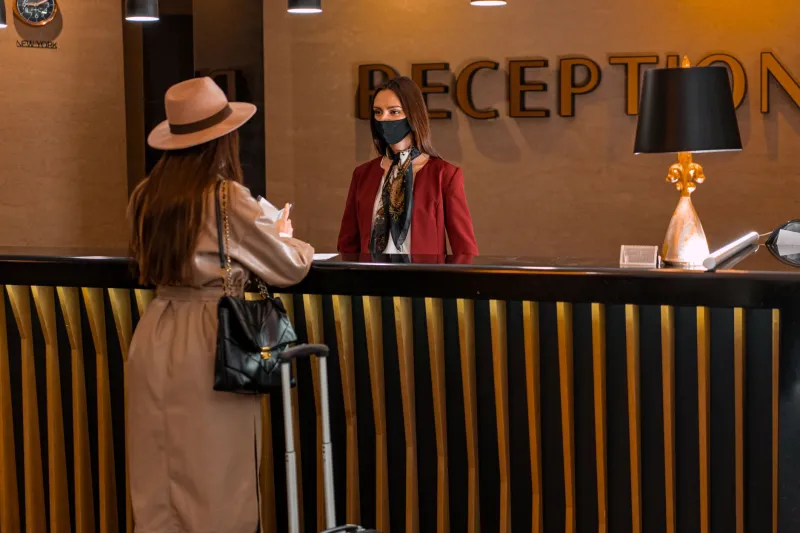
Reception is the first human point of contact. Ask whether the front desk will know the event name, the room name and the name of the morning contact. Test the route from the main entrance to the training room without asking for help. Signage should be present at the entrance, at lift lobbies, at stairwells and at any turning point where a reasonable person could hesitate. A floor directory that still lists last month's conference is worse than no directory at all.
For larger bookings, clarify the venue's policy on temporary signage. Some sites permit branded direction boards; others do not. If forty delegates arrive between 08:40 and 08:55, a single receptionist dealing with routine enquiries will create a queue. The booking should state whether additional reception support is provided and at what time.
Lifts, stairs and cloakroom capacity
Vertical circulation is easily overlooked. Check lift capacity and speed, stair access and the availability of accessible routes. A room described as being on the first floor may be perfectly suitable, but if the only lift serves a large shared lobby and delegates arrive in a block, the queue becomes part of the morning. Ask how deliveries and catering trolleys share the same circulation routes.
Cloakroom capacity should be assessed against the season. A summer workshop may require little more than a bag rail; a November event in Manchester or Edinburgh will bring coats, umbrellas and overnight bags. Confirm whether hanging space is staffed, secure and sufficient, or whether movable rails can be placed near the room. If the reception area doubles as the cloakroom, inspect it at arrival time rather than at midday.
Refreshments at the point of arrival
Coffee provision is often specified as a mid-morning item when it is really an arrival item. Ask when refreshments will be ready, where they will be positioned and how queues will be managed. A separate refreshment point away from registration is usually preferable. Confirm the availability of water, cups, dietary milks and refills, and establish who is responsible for replenishment during the first hour. If the venue requires catering staff to set up after the room is released, the timing should be written into the schedule.
AV power-up time
A projector that works when tested in an empty room may still take several minutes to wake, handshake with a laptop and accept the correct source. The inspection should include a full power-up at the time delegates will arrive, not only a check that the screen descends. Confirm audio levels, HDMI or USB-C connections, hybrid camera framing and the presence of a technician. Ask who resets the system if a previous booking has left it in an unfamiliar configuration. A fifteen-minute buffer before the welcome slide is a reasonable specification, not a luxury.
The named morning contact
The most important arrival specification is a person. The booking should identify a named contact who will be on site at the agreed time, reachable by mobile, and authorised to resolve access, catering and AV problems. A general events inbox is not a substitute. Confirm the backup contact and arrange a short call or email exchange forty-eight hours before the event. This single step prevents most first-hour escalation.
A first-hour timeline for the inspection visit
A useful way to test arrival is to walk the sequence as delegates will experience it. At 08:00, confirm that the named contact is present and that the room is unlocked. By 08:15, test the AV from a cold start and check the layout against the plan. At 08:30, inspect reception, signage and the route to the room. From 08:45, observe how the building copes with a realistic arrival flow; if a viewing visit cannot coincide with an event, ask the venue to describe its busiest comparable booking. By 09:00, confirm refreshments are available and that cloakroom arrangements are working. The training day should be able to begin at 09:15 without unresolved logistics.
Questions to put in writing
The booking file should record the exact arrival instructions, the named contact and backup, parking and drop-off arrangements, reception notification, signage permissions, lift and stair access, cloakroom capacity, refreshment timing, AV power-up responsibility and the venue's procedure for late or delayed delegates. These are not hospitality extras. They are the operational conditions under which learning can begin.
A training room is judged before the first slide appears. Hirers who audit the arrival experience with the same care as the teaching space protect the trainer's opening, the delegates' attention and the credibility of the day. The first hour is not a soft consideration; it is the threshold through which every other element of the booking must pass.