Where the Sockets Are: Auditing Power Provision Before a UK Training Room Booking
Photo: BrokenSphere, CC BY-SA 3.0, via Wikimedia Commons
Most training room enquiries begin with the familiar three variables: date, delegate numbers and preferred layout. Electricity tends to arrive much later, typically in the week before the session, when somebody asks whether the room has enough sockets. By that stage the options are narrow, and the answer is often that an extension lead can be run in from the corridor.
That is not a satisfactory foundation for a professional learning event, and it is rarely necessary. Power provision deserves the same scrutiny as chairs, lighting and acoustics, because it underpins almost everything else a modern training day requires.
Establish the demand before judging the supply
A power audit begins with arithmetic, not with the room. List every device that will be present and estimate its draw.
- Delegate laptops: a modern ultrabook charger typically draws between 45 and 65 watts. Sixteen laptops amount to roughly one kilowatt.
- Facilitator workstation: one laptop, occasionally a second screen.
- Projector or large-format display: 150 to 400 watts, depending on technology and brightness.
- Audio: powered speakers, a mixing desk, radio microphone receivers and a hearing loop amplifier.
- Hybrid kit: camera, encoder, confidence monitor and, increasingly, a small lighting panel.
- Workshop equipment: 3D printers, testing rigs, soldering stations or sewing machines, depending on the subject.
- Catering: urns and kettles are the hidden load. A 3kW urn alone occupies most of a 13-amp socket.
Added together, the total is usually modest in absolute terms — three or four kilowatts for a well-equipped classroom. The difficulty is not the sum but the distribution. Sixteen laptops will not charge comfortably from two wall plates at the far end of the room.
Placement matters more than quantity
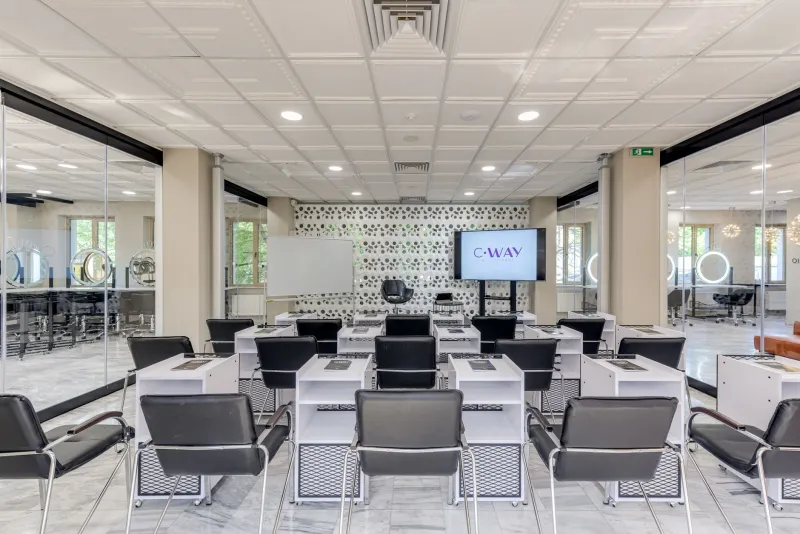
A venue that advertises ample sockets may mean four double sockets behind the presenter's position. For a cabaret layout with delegates facing forward, that arrangement serves the facilitator and nobody else.
Ask for a plan showing socket positions and check three things. First, whether floor boxes sit within reach of the delegate tables, or whether power is confined to the perimeter. Second, whether sockets are at skirting level, which forces cables across walking routes, or at desk height. Third, whether any socket runs on a circuit independent of the lighting, so that a trip does not plunge the session into darkness.
Cable runs are a safety matter as well as a practical one. Leads trailing across a fire escape route, or looped between tables in a darkened room, create a genuine risk that no amount of signage fully mitigates. Cable ramps, suitable tape and a considered furniture plan are the minimum.
Circuits, load and the questions worth asking
A UK double socket is rated at 13 amps per outlet, but the circuit behind it is usually a 32-amp ring main shared with other rooms. The critical question is what else sits on that circuit. If the training suite shares a distribution board with the adjoining kitchen, the urns at 10.30am may be the reason the projector flickers.
Ask the venue directly:
- Which circuits serve the training room, and what else do they supply?
- When was the fixed installation last inspected, and is a current Electrical Installation Condition Report available?
- Are the portable appliances in the room — kettles, projectors, leads — PAT tested, and can evidence be produced?
- Is there residual current device protection on the sockets, and where is the consumer unit?
- Who is the venue contact for electrical faults on the day, and how quickly can that person attend?
These are ordinary questions for a professionally run venue and should cause no offence. A venue unable to answer them is telling you something useful.
Extension leads are a controlled risk, not a solution
Extension leads are legitimate equipment when used properly and a hazard when improvised. Guidance from the Health and Safety Executive is clear that coiled leads can overheat, that daisy-chaining multiplies risk and that leads should be fully unwound when carrying a significant load.
Where leads are required, specify them rather than improvising. Fused, surge-protected four-way blocks with a lead of adequate length are preferable to a chain of domestic extensions. Confirm whether the venue supplies cable ramps or whether you will bring them, and agree who tapes down runs and who removes the tape afterwards. Adhesive residue on a hired floor is exactly the sort of detail that reappears as a cleaning charge.
Charging as a scheduling problem
Even a well-supplied room will struggle if thirty delegates all seek power at 11am. Treat charging as a timetable question. A charging station at the rear of the room, with two multi-way blocks and a legible sign, absorbs most demand during breaks. Ask delegates to arrive with devices charged and to bring a portable battery if their work depends on a full day of screen time.
Where the session is genuinely power-hungry — software training, video work, data analysis — consider specifying a room with dedicated desk-level power, even at a higher day rate. The alternative is a day punctuated by negotiations over sockets, which is not what anybody booked.
Put it in writing
The final step is documentary. Record the agreed socket count and positions, the venue's responsibility for leads and ramps, the PAT and inspection position, and the named contact for faults. Add this to the same schedule that covers layout, catering and access times.
Power is unglamorous and rarely mentioned in the post-event review. That is precisely the point: when it is specified properly, nobody notices it at all.