The Half-Day Arithmetic: Auditing the Minutes a UK Training Room Booking Really Yields
Half-day room hire occupies a curious place in UK training planning. It sounds efficient: a morning or afternoon slot, a focused agenda, and a fee that sits comfortably below a full day. Yet the phrase half-day describes the booking, not the learning. A room hired from 09:00 to 13:00 is available for four hours; the programme inside it rarely receives four hours of attention. The difference is not a minor administrative detail. It is the gap between what an organiser reserves and what a facilitator can realistically use.
The advertised slot and the learning slot
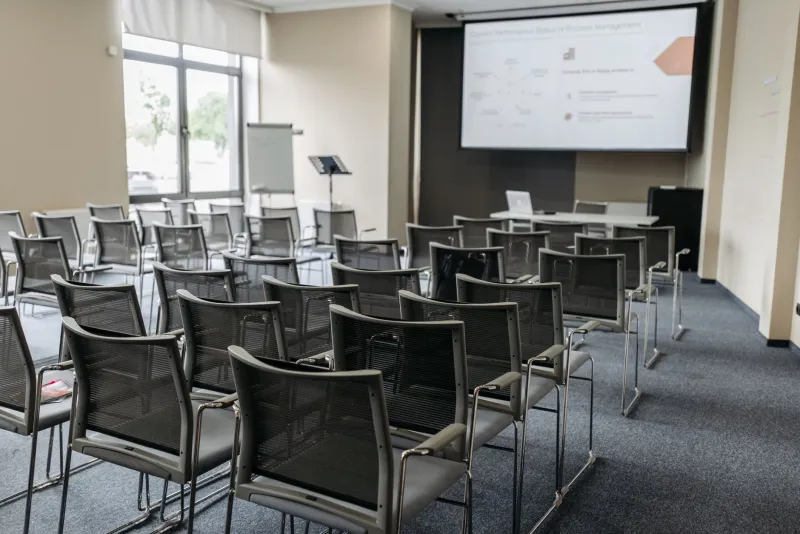
UK venues commonly sell training rooms in morning, afternoon or full-day bands. The contract may state 09:00 to 13:00, with access from the start time and departure by the end. In practice, the learning clock begins later. Delegates arrive over a twenty-minute window, negotiate coats and coffee, locate the right room and settle into seats. The facilitator may need to reconnect a laptop, test audio, arrange handouts or adjust the layout. Even when the room is well prepared, the first substantive teaching moment seldom coincides with the hour printed on the booking form.
The same applies at the other end. A session that runs to 12:55 leaves little room for questions, closing remarks, feedback forms and a dignified exit. If the venue requires the room to be clear by 13:00, the final minutes become an exercise in packing rather than learning. The half-day has not been wasted, but it has been quietly reduced.
Where the minutes go
The losses are rarely dramatic in isolation. They accumulate through ordinary, predictable intervals. Arrival and registration may take fifteen to twenty-five minutes. A welcome and domestic announcements may take another ten. A mid-morning break of fifteen minutes often stretches to twenty once queueing and conversation are included. A room reset after a group exercise may take ten minutes. Pack-down, feedback and departure may consume a further ten to fifteen. None of these activities is unnecessary. The problem is that they are frequently absent from the agenda and from the organiser's expectation of what a half-day can hold.
There is also the question of readiness. A room that is available at 09:00 is not necessarily a room that is ready at 09:00. Tables may still be in boardroom layout, the projector may need a source change, and the catering may arrive at the same moment as the first delegates. Access time and setup time are related but distinct. A booking strategy that treats them as identical will consistently lose productive minutes.
Calculating the realistic learning window
A simple arithmetic discipline helps. Start with the booked duration in minutes. Deduct the time before the first learning activity, the time after the last learning activity, and the breaks that fall inside the slot. What remains is the realistic productive window, not the room hire period.
For example, a 09:00 to 13:00 booking provides 240 minutes. If access begins at 08:45, the facilitator has fifteen minutes for setup. Delegates arrive from 08:45, the welcome begins at 09:15, and a twenty-minute break is taken at 10:45. The session closes at 12:40, followed by fifteen minutes for pack-down and departure. The learning window is 09:15 to 12:40, less the twenty-minute break: 185 minutes, or just over three hours. That is still a useful half-day, but it is not four hours. The agenda should be built for 185 minutes, not 240.
This calculation need not be precise to the minute. Its value lies in making the hidden intervals visible before the programme is designed. A facilitator who plans three hours of content for a four-hour booking is not necessarily overambitious; a facilitator who plans four hours of content for the same booking is relying on an illusion.
Specifying access and buffer periods
Access is the first item to clarify. Organisers should ask when the room can be entered, whether setup is included in the fee and whether the venue can hold the room for a short period before the official start. A thirty-minute access buffer is often more valuable than an extra fifteen minutes at the end, because it allows the facilitator to test technology and arrange the room without an audience.
The booking should also specify the reset expectation. If the programme uses cabaret tables, breakout corners or a clear floor space, the room may need to be returned to its standard layout before departure. That work belongs in the schedule. So does egress: the time required to collect materials, speak to delegates and leave the premises. A half-day booking that ends at 13:00 but assumes a 13:15 departure is not a half-day booking in practice; it is a half-day plus an unacknowledged buffer.
Resetting expectations with stakeholders
Internal stakeholders often read half-day as a fixed quantity of content. A more honest approach is to present the room hire window and the learning window separately. The agenda can show arrival from 09:00, a prompt start at 09:15, a stated break, and a close at 12:40. That clarity benefits delegates as well as facilitators. It signals that late arrival has a cost and that the programme has been designed for the time available.
Where the learning objective genuinely requires three and a half hours of uninterrupted work, a half-day booking may still be the wrong instrument. A full day, or a half-day with pre-work and a follow-up session, may be more appropriate. The aim is not to inflate bookings but to match the room hire period to the learning design.
A container, not a guarantee
In 2026, UK training budgets remain under scrutiny, and half-day room hire will continue to appeal. That appeal is legitimate. The mistake is to treat the four-hour slot as four hours of teaching. A room booking is a container. What it holds depends on the access, setup, breaks, resets and departure arrangements that surround it. Organisers who audit those intervals before signing the agreement will make better decisions, and facilitators will inherit a room that supports the programme rather than quietly eroding it.