Ink, Adhesive and Wall: Auditing the Low-Tech Toolkit of a UK Training Room

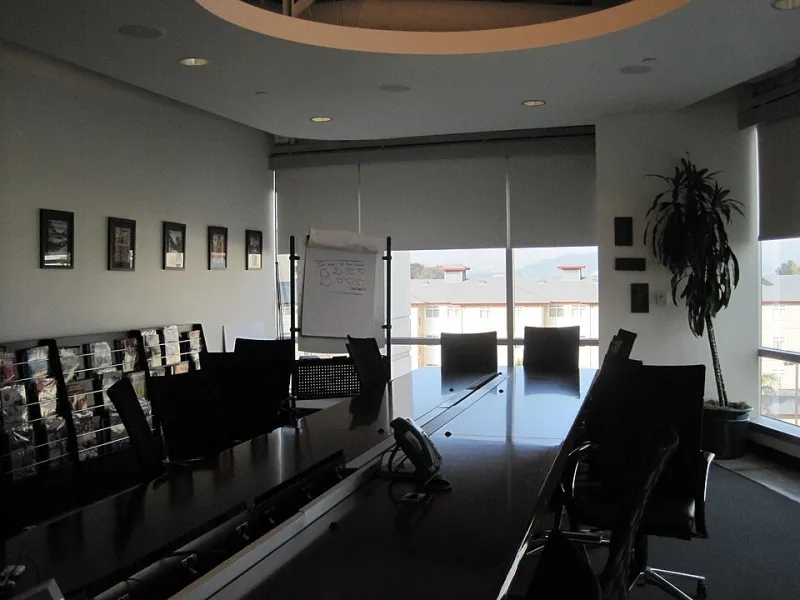
Photo: flipchart easel with coloured marker pens and sticky notes in a meeting room, via i.pinimg.com
The Tools Nobody Books a Site Visit For
A training room can be specified down to the last HDMI adapter and still fail at the first group exercise, because the whiteboard is a ghosted grey, the flipchart easel has a broken leg, and the walls will not accept a sticky note. These are not glamorous considerations. They are, however, the infrastructure on which most collaborative work in UK training rooms actually rests.
Rooms are routinely inspected for projectors, seating and acoustics. The analogue toolkit — pens, paper, adhesive, and the vertical surfaces that make thinking visible — is usually assumed. This article proposes that it be audited with the same discipline.
Surfaces: Condition Before Quantity
The presence of a whiteboard is not evidence that it can be written on. Ask to see it wiped. A board that retains a grey haze after cleaning has been written on with the wrong pen and left; the residue will make new ink indistinct and the room will look unkempt throughout the day.
Four attributes matter. Finish: a glossy melamine board is cheap and shows every mark; a enamelled steel board costs more and lasts. Ghosting: check corners, where residue accumulates. Magnetism: if you intend to use printed materials, magnetic boards and clips are worth specifying. Position: a board mounted behind a projector screen, or across a wide room from the seated group, will be used less than it should be.
Glass boards deserve a mention. They are increasingly common in modern UK meeting spaces, photograph well, and mark easily if the wrong pens are used. If a venue supplies glass, confirm which pens are approved; solvent-based markers can be difficult to remove entirely.
Pens: The Supply Problem
A dry marker is a small failure that interrupts a session disproportionately. Supplies are frequently the first thing a venue economises on, and the result is a room with one working pen and six that squeak.
Ask how many markers are provided per flipchart and per board, whether spares are held on site, and whether they are replaced during the day or only between bookings. Chisel tips are more useful than bullet tips for anything that will be read from a distance. Low-odour formulations matter in small, poorly ventilated rooms; the smell of solvent in a warm room after lunch is a genuine distraction.
Where the programme depends on colour — and much facilitation does, for coding themes or separating options — confirm that more than one colour is available in usable condition. A venue that supplies a single black marker has supplied a whiteboard, not a working tool.
Permission to Affix: The Question That Should Be Asked First
Wall work is the most effective way to make group thinking visible, and the most likely to breach a hire agreement. Damage deposits are commonly levied when adhesive marks paintwork or lifts vinyl wallpaper, and a facilitator who has taped forty sticky notes to a freshly decorated wall will discover this at considerable cost.
Before the booking is confirmed, ask four things.
- Is there a designated wall or pinboard area where materials may be affixed?
- Which adhesives are permitted, and which are prohibited?
- Are there wall areas that are explicitly out of bounds, and are they marked?
- What is the venue’s position on damage charges arising from permitted use?
Masking tape is often assumed to be safe. On emulsion paint it can lift the surface; on some modern vinyl wallcoverings it leaves a residue. Low-tack products are safer, and painter’s tape safer still, but the only reliable answer is the venue’s own. Some venues will supply protective sheeting or portable display panels for exactly this purpose. Ask whether they exist before concluding that the room cannot support wall work.
Sightlines and Legibility
Visible thinking is only useful if it can be seen. A wall that is technically free may sit at an oblique angle to half the room, or behind a pillar, or beyond the point at which handwriting becomes legible.
A useful rule of thumb for hand-lettering is a minimum character height of around 25mm per ten metres of viewing distance. In a room twenty metres deep, that means headings of at least 50mm and generous line spacing. Boards placed low on a wall are unreadable from the back; boards placed behind a top table are inaccessible.
In hybrid rooms the constraint doubles. If a camera is fixed on the presenter, the flipchart beside them may be outside the frame. Ask whether the room’s camera can be repositioned, or whether a document camera is available to capture analogue output for remote participants. Without this, the wall work is invisible to anyone online.
Consumables, Storage and the End of the Day
Sticky notes are worth specifying by size and adhesion. Notes that curl and fall overnight will scatter across the floor and deprive the next morning of its starting point. Larger notes for group output and smaller notes for individual contributions is a distinction worth building into the kit list.
Establish where materials are stored, who replenishes them, and whether the venue charges for consumables separately or includes them. A modest supply cost that appears on the final invoice is preferable to a shortage at ten o’clock.
Finally, consider what happens to the output. Photographing walls at the end of a session is standard practice, and raises two questions: whether the venue permits photography in the room, and how images containing delegate handwriting or names will be stored and shared. A short line in the data protection notice is usually sufficient, but it should be written before the day, not afterwards.
A Short Audit Checklist
- Wipe-test the whiteboard and note ghosting.
- Confirm magnetic capability if printed materials will be used.
- Count working markers per surface; check colours and tip type.
- Confirm the number and stability of flipchart easels.
- Ask in writing which adhesives are permitted and where.
- Check wall visibility from the furthest seat.
- Confirm camera coverage of flipchart and wall areas for hybrid delivery.
- Clarify consumables charging and replenishment arrangements.
The analogue toolkit is inexpensive and unglamorous, which is precisely why it is overlooked. It is also, for most training days, where the thinking becomes visible. It repays a few minutes of interrogation.